Case Details
Demand Background
GNSS systems fail not because of accuracy, but because of signal integrity and availability.
- No GNSS signal in indoor environments
Testing, validation, and system integration cannot be performed due to signal blockage
- Severe signal degradation under interference
Weak GNSS signals are easily suppressed, leading to unstable or lost positioning
- Unreliable test conditions
Different devices operate under inconsistent signal environments, making results non-repeatable
- Lack of trusted GNSS signal source
Systems cannot distinguish between clean and corrupted signals
👉 Core issue:
GNSS signals are unavailable, unstable, and untrusted in real-world and test environments
Product Solution
This solution uses dual AJT105S + GNDA4 to generate, process, and distribute clean GNSS signals for controlled and reliable operation.
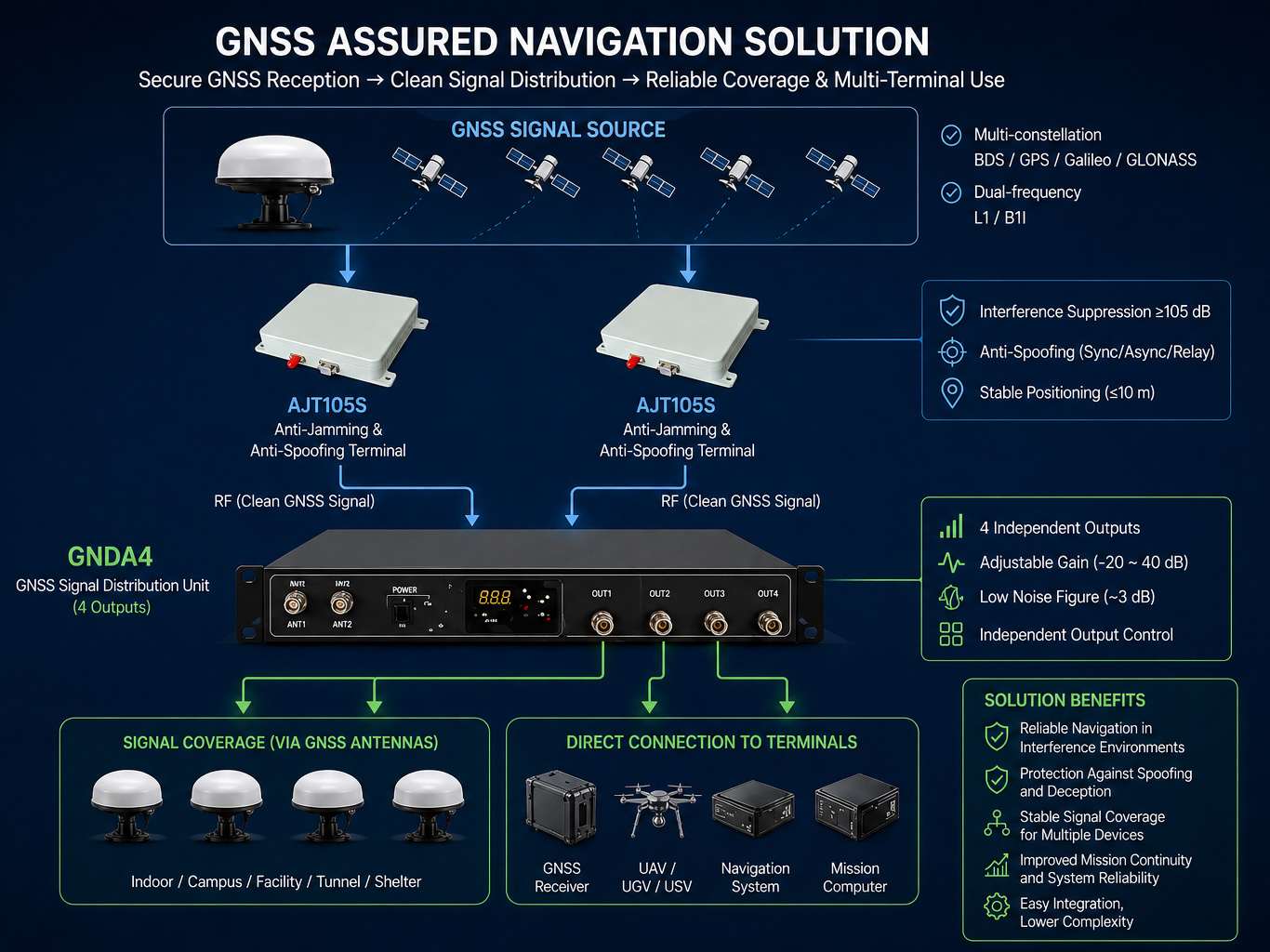
Step 1: Clean GNSS Signal Generation (AJT105S ×2)
- Each AJT105S receives live GNSS signals and performs:
- Anti-jamming (≥105 dB interference suppression)
- Anti-spoofing (sync / async / relay protection)
- Outputs clean and trusted GNSS RF signals via RF interface
👉 Result:
Corrupted signals are filtered, only verified GNSS signals are passed forward
Step 2: Signal Amplification & Distribution (GNDA4)
- Receives clean GNSS RF signals from AJT105S
- Performs:
- Signal amplification (adjustable gain up to 40–60 dB)
- Low-noise conditioning (~3 dB NF)
- Multi-channel distribution (4 independent RF outputs)
👉 Result:
Stable, amplified GNSS signals delivered to multiple endpoints
Step 3: Signal Coverage & Multi-Terminal Use
GNDA4 outputs can be used in two ways:
- GNSS signal coverage via antennas
→ Indoor / facility / tunnel GNSS signal extension
- Direct RF output to terminals
→ GNSS receivers, UAV systems, navigation units
👉 Result:
Controlled GNSS environment for testing and deployment
Typical Application Scenarios
1. Indoor GNSS Testing (Core Scenario)
- UAV and navigation system testing in lab environments
- Repeatable, controlled GNSS signal conditions
- Multi-device synchronized validation
2. Interference Environment Compensation
- Maintain GNSS availability in jammed or degraded environments
- Provide clean and stable signal source for critical systems
Solution Value
Create a controlled, clean, and reliable GNSS signal environment
- Ensure signal integrity
Only clean, anti-jammed, anti-spoofed GNSS signals are used
- Enable indoor and controlled testing
GNSS becomes usable in environments where it normally fails
- Support multi-system operation
One signal source drives multiple devices consistently
- Improve reliability in interference conditions
Maintain navigation capability under real-world threats
Deliver clean GNSS signals where they are needed, when they are needed, without compromise

